Research

Mechanisms of bacterial defense and phage counter‑defense

Bacteria and archaea are under constant assault from phages and other genetic parasites. They defend themselves with diverse immune systems, and phages in turn carry proteins and RNAs that subvert these defenses. We aim to discover these immune systems, determine how they work, and repurpose them for applications in biotechnology and medicine.

How we work

From genomes to structures

  1. Discover and select

    Bioinformatics

    We search bacterial and archaeal genomes for candidate defense systems, place them on phylogenetic trees and compare their gene neighborhoods to choose which systems to test.

    Profile (HMM) searches · Phylogenetics · Gene-neighborhood analysis · TreeMapper

    More on bioinformatics →
    Skip the TreeMapper demo
    TreeMapper · example session Open full screen

    Simulated example, not a real analysis: 64 reverse-transcriptase loci on either strand, flipped so each RT points forward and aligned on the RT gene, with plaque-assay results and the reduction in efficiency of plating.

  2. Test the defense

    Phage biology

    Candidate systems are expressed in bacteria and challenged with phages. Plaque assays measure protection, and phages that escape point to what triggers or blocks the defense.

    Spot and plaque assays · Efficiency of plating · Escape phages · Phage isolation

    More on phage biology →
  3. Find the mechanism

    Biochemistry

    We purify the immune complexes and reconstitute their activities to determine what they recognize, what they make or cut, and how phage proteins switch them on or off.

    Protein purification · Nuclease, polymerase and ATPase assays · Reconstituted complexes

    More on biochemistry →
  4. Validate with structures

    Structural biology

    Cryo-EM structures show how each complex assembles and test the mechanisms suggested by genetics and biochemistry.

    Single-particle cryo-EM · cryoSPARC and RELION · Model building in Phenix, ChimeraX and ISOLDE

    All 30 structures →

Defense and counter-defense

Immune systems that bacteria use against phages, and the proteins and RNAs phages use to subvert them.

3D model of PDB 9NLV: SenDRT9 RT–ncRNA hexamer

Reverse transcriptase–based defense

Defense-associated reverse transcriptases

DRT9 systems defend against phage by making DNA rather than destroying it. Phage infection triggers synthesis of poly-dA, primed by the reverse transcriptase itself, which drives abortive infection.

Cryo-EM structures of SenDRT9 from Salmonella enterica show how a non-coding RNA serves as both a structural scaffold and the reverse-transcription template for a hexameric complex. Tyrosine residues in the reverse transcriptase probably prime DNA synthesis, and poly-dA synthesis in vivo is set by the competing activities of phage-encoded triggers and host-encoded silencers.

Key paper

3D model of PDB 9N6B: Retron I-A complex, HNH nuclease “up”

Reverse transcriptase–based defense

Retrons

A type I-A Retron assembles RNA, DNA, a reverse transcriptase, an HNH nuclease and four SMC-family ATPases into a 364 kDa anti-phage complex.

Phage-encoded nucleases trigger degradation of the Retron-associated DNA, which activates the HNH nuclease. The nuclease cleaves tRNA-Ser, stalling protein synthesis and arresting phage replication.

Key paper

3D model of PDB 8UX9: PARIS immune complex (AriA6–AriB3)

8UX9 is one asymmetric unit (AriA2–AriB1); it is drawn here as the C3-symmetric AriA6–AriB3 complex.

Protein-sensing defense

PARIS

Six AriA ATPases form a propeller-shaped scaffold that holds three AriB nucleases. Detection of phage proteins releases AriB, which cleaves host tRNA-Lys.

PARIS is often encoded in phage genomes, where it protects the host from competing genetic parasites. Phage T5 escapes by expressing its own lysine tRNA that PARIS does not cleave.

Key paper

3D model of PDB 6W1X: Anti-CRISPR AcrIF9 bound to the Csy complex

Adaptive immunity · where the lab started

CRISPR–Cas systems

We solved early structures of CRISPR surveillance complexes and study how the Cas1–Cas2/3 integrase adds new spacers at the leader, and how anti-CRISPR proteins inhibit these systems.

Structures of E. coli Cascade and the Pseudomonas aeruginosa Csy complex showed how CRISPR RNA-guided surveillance complexes recognize foreign DNA. Recent structures show how the Cas1–Cas2/3 integrase captures and integrates foreign DNA, and how a type III-Bv complex post-translationally modifies an associated toxin.

Key papers

Beyond defense systems

Tools built from immune systems, viral genomics, and genetic conflict in other genomes.

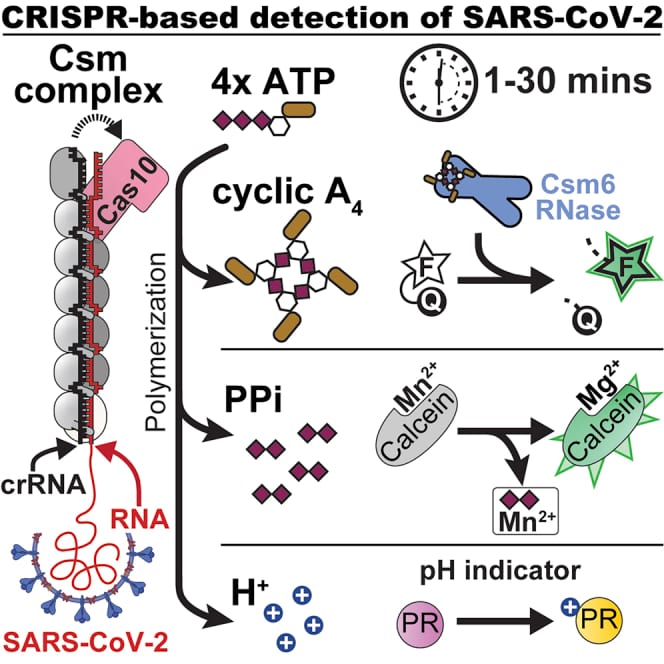
Graphical abstract: the type III CRISPR (Csm) complex recognizes SARS-CoV-2 RNA and Cas10 makes cyclic oligoadenylates, pyrophosphate and protons that are read out by fluorescence or colour
Graphical abstract, Cell Reports Medicine 2021 (CC BY)

Tools for biotechnology and medicine

Genome engineering and diagnostics

We use existing genome-editing technologies, and create new ones, for loss- and gain-of-function studies of host–parasite interactions in humans, plants and insects.

During the COVID-19 pandemic the lab repurposed the type III CRISPR system as a diagnostic for SARS-CoV-2. Related work repairs CRISPR-guided RNA breaks for site-specific RNA excision in human cells and engineers RNA viruses.

Key papers

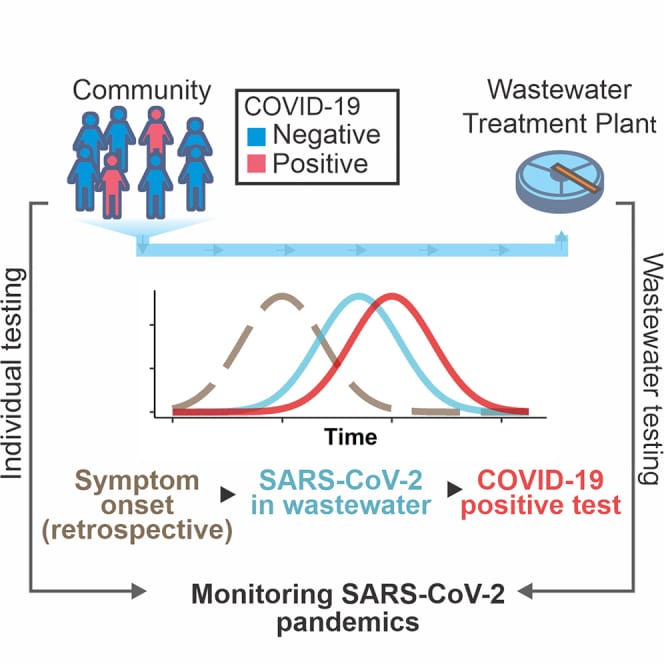
Graphical abstract: SARS-CoV-2 RNA in wastewater rises after symptom onset and before positive clinical tests
Graphical abstract, Cell Reports Medicine 2020 (CC BY-NC-ND)

Viral genomics

SARS-CoV-2 genomic surveillance

During the COVID-19 pandemic the lab monitored SARS-CoV-2 in municipal wastewater and used global phylogenomics to follow the evolution of the virus.

Viral RNA in wastewater followed symptom onset and preceded clinical test results. Phylogenomics revealed frequent truncations of ORF7a that negate its anti-immune activity, and a retrospective analysis followed the rise and fall of variants through Omicron.

Key papers

Bioinformatics and phylogenetics

CRISPR leaders and adaptation

Bacteria and archaea acquire resistance to genetic parasites by integrating short fragments of foreign DNA at the leader end of a CRISPR.

An analysis of 37,477 CRISPRs from bacterial and archaeal genomes revealed 87 subtype-specific leader motifs that improve CRISPR detection and subtype annotation. Earlier work on 15,274 leaders showed that the phase of these motifs is critical for CRISPR adaptation.

Key papers

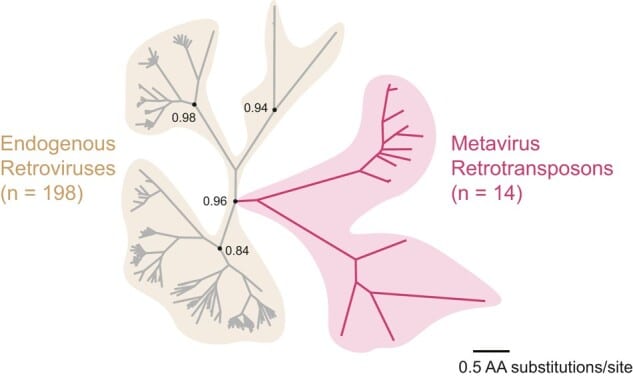
Phylogenetic tree of capsid genes from endogenous retroviruses and Metavirus retrotransposons
Figure 1, Molecular Biology and Evolution 2024 (CC BY)

Genetic conflict in mammalian genomes

Domesticated capsid genes

Selfish genetic elements make up large fractions of mammalian genomes, and host genomes occasionally domesticate these elements for function.

Using a complete human genome assembly and 25 other vertebrate genomes, we traced at least five independent domestications of capsid genes from Metaviridae, a lineage of retrovirus-like retrotransposons. Two of these genes, PNMA1 and PNMA4, maintain reproductive capacity.

Key papers

Structures

30 structures in the Protein Data Bank

From early crystal structures of viral proteins (2004) to recent cryo-EM structures of DRT9, Retron and PARIS anti-phage defense systems. Every deposited model can be turned in 3D.

Browse the structures